
Reviewed · UNESCO SITES
Jeju Island UNESCO Heritage Bus Tour
Jeju Island is a place where volcanoes, sea cliffs, and local culture all share the same space, and this 2-day UNESCO-focused bus tour is a smart way to hit the big geology without juggling buses. I like that your route is built around key UNESCO sights like Seongsan Ilchulbong and the Manjang Cave area, plus hands-on cultural stops. I also like the practical rhythm, with time on-site that keeps you moving but not rushed.
One thing to consider is that several stops are weather or closure dependent. Right now, Manjang Cave is noted as closed for construction until August 2025, and rainy days swap in indoor options like Haenyeo Museum or Jeju Art Circus.
Key points to know before you go
- UNESCO highlights in two days: Seongsan Ilchulbong and the Manjang Cave area, plus Jusangjeolli Cliff under UNESCO Geo Parks
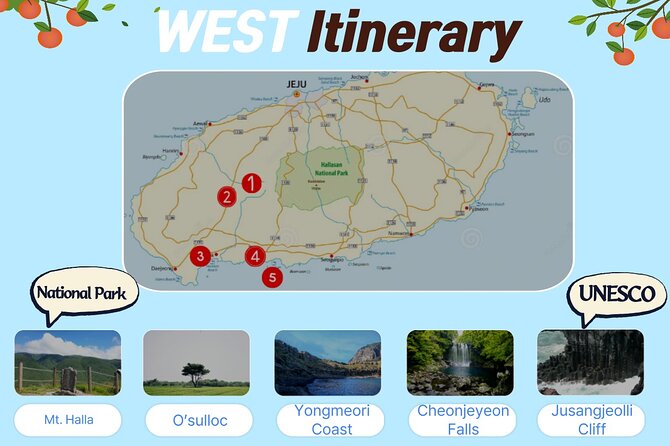
- East vs West scheduling: different days run Western Jeju or East Jeju, with a K-drama themed timetable that shapes the route
- English support depends on group size: small groups may have an advanced English taxi driver, while bigger groups get a professional English-speaking guide
- Expect substitutions: rainy weather and site closures change the plan, including Manjang Cave and sometimes Yongmeori Coast access
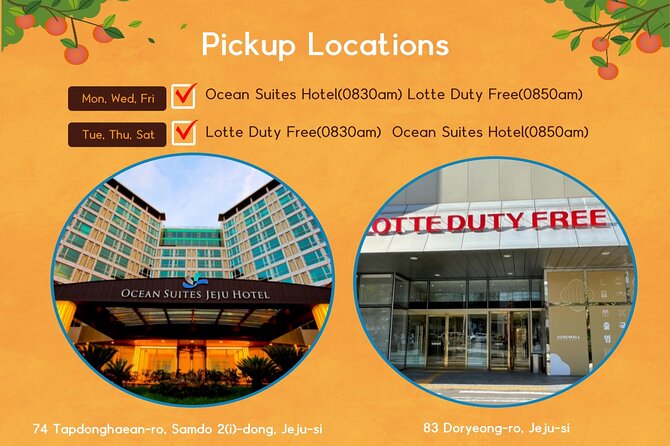
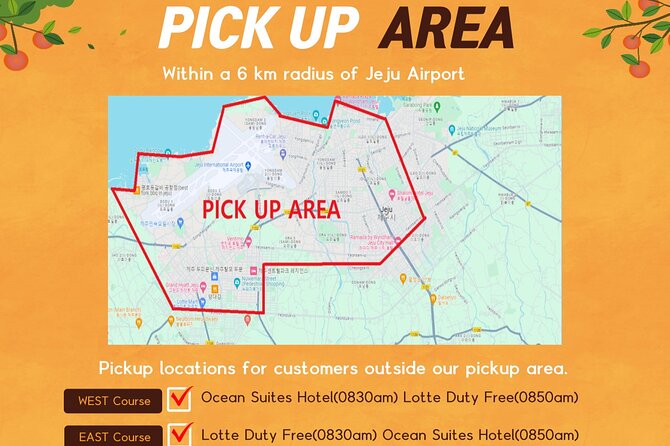
- Pickup is convenient, but limited: hotel pickup and drop-off are within Jeju city downtown only, with an extra charge outside that area
Why this Jeju UNESCO bus tour works when time is tight
If you only have a short window on Jeju, your biggest enemy is planning. This tour is designed to do the hard part for you: cluster major sites by region and keep the pace steady across two full days. That means less time figuring out connections and more time looking closely at what makes Jeju special, from volcanic craters to coastline formations.
I also like that the tour is honest about its reality. Jeju weather matters. Ocean access matters. Even the cave schedule can shift due to safety work. Instead of pretending everything will always be open, the itinerary builds in alternatives, so you are not stuck staring at a closed gate for hours.
The price is $125 per person for the full two-day package, and the value comes from what you avoid. You are paying for transportation, hotel pickup and drop-off inside Jeju city downtown, and a driver plus English language support. If you were to hire private rides for multiple stops, this stops looking expensive fast.
More UNESCO sites around Jeju:
- Jeju: Eastern Jeju UNESCO Spots Day Tour
★ 4.9 · 1,148 reviews - East Jeju Essentials – Seongsan Ilchulbong (UNESCO) & Haenyeo
★ 5.0 · 939 reviews - Jeju: Southern Top UNESCO Spots Bus Tour
★ 4.9 · 648 reviews
Pickup, vehicles, and the English question (English guide vs driver)

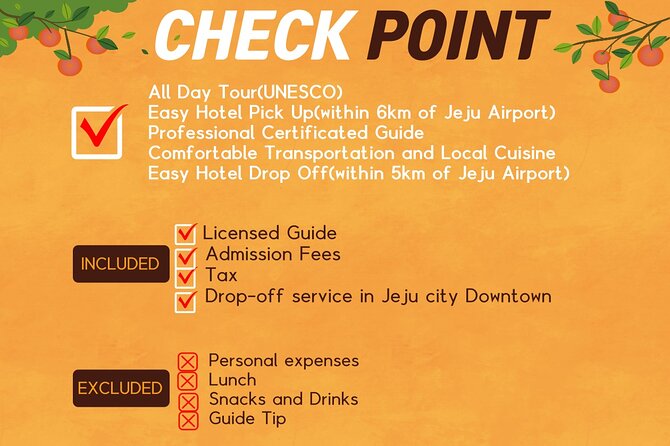
Here is the practical setup. There is hotel pickup and drop-off included, but only within Jeju city downtown. If your hotel is outside that zone, there is an extra fee of 80,000 KRW one way.
You will ride in a vehicle based on your group size: a 15-seater van, a minibus, or a larger bus. The tour is set up with a minimum group size of 13 travelers to proceed, which is how they keep the logistics smooth.
Now for English. The tour can operate with different support levels depending on the number of people:
- Up to 4 individuals: you may join at the same price using a regular taxi with an advanced English-speaking driver
- 5 to 10 people: an English-speaking guide (professional English-speaking guide)
- 10+ people: the operator makes efforts to arrange an English-speaking guide with a van, minibus, or bus
One review-style detail that matters for your expectations: I would not assume you will always have a separate, fully independent guide standing with the group all day. In at least one case, the driver handled a lot of the interaction and waiting. So if having a full-time guide is your top priority, message the operator before booking and ask what role the driver will play for your specific group size.
The day-by-day route, and what each stop feels like
Day 1: From forest trails to Seongsan Ilchulbong, then coastline geology
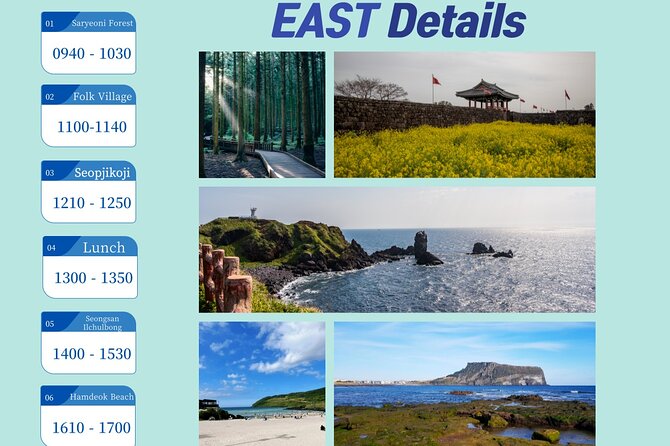
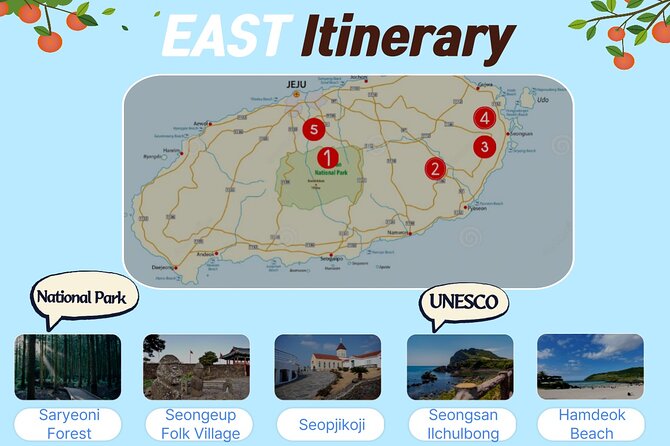
Day 1 is built around eastern Jeju scenery and geology, with several free admission nature and culture stops, then major UNESCO coverage.
More Historical Tours in Jeju
- Private Full Day Tour World Natural Heritage & UNESCO in jeju
★ 5.0 · 9 reviews - Jeju UNESCO Natural Heritage Private Tour by Certified Guide
★ 5.0 · 5 reviews - Jeju Day Tour – World Heritage & UNESCO
★ 5.0 · 4 reviews - From Busan: Gyeongju UNESCO World Heritage Guided Day Tour
★ 4.8 · 1,250 reviews
Saryeoni Forest Path
This is one of Jeju’s noted protected forest paths, and it is popular with people who like an actual walk, not just a quick photo stop. You get about 50 minutes here, and the admission is free.
What to expect: a calmer pace and a break from coastal winds. If you are traveling in shoulder season, this tends to feel like the most “local Jeju” part of the day.
Seongeup Folk Village
This traditional village is preserved in its older form, including stacked stone structures designed to protect roofs from wind. It also connects to Joseon era defensive building ideas, specifically homes and castles meant to help protect against Japanese invasion.
You get about 50 minutes, and admission is free. This is the stop where you slow down and look at architecture details, not views.
Seopjikoji
Seopjikoji is known for strong scenic appeal, and the itinerary notes canola bloom timing in April. It is an eastern shore area, so you also get that strong sea horizon feeling.
You get about 40 minutes and admission is free. Also, there is a seasonal swap: in October, Seopjikoji can be replaced with Sangumburi.
Seongsan Ilchulbong (Sunrise Peak), UNESCO and the women diver show
This is the centerpiece. Seongsan Ilchulbong is a tuff cone created by hydrovolcanic eruptions on a shallow seabed around 5,000 years ago. It is about 182 meters high, with a preserved bowl-like crater and visible internal structures from sea cliff exposure.
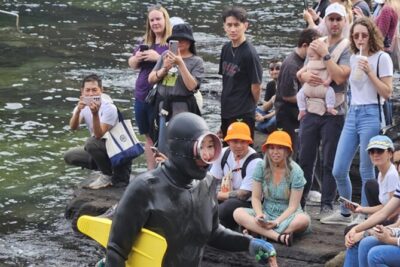
Timing here is about 1 hour 20 minutes, and the admission ticket is included. The women diver show is also included in this UNESCO stop.
This is worth it for two reasons. First, the geology is not abstract. You can stand in a place shaped by ancient underwater explosion. Second, the women diver show connects the stone and the sea to Jeju’s working culture.
Jongdal-ri and the northeastern coastline pass
This part is more about the drive and the coastline views. The bus goes past Hado Beach and Saehwa Beach, then continues toward Manjang cave area. Jongdal-ri Shore Road is noted for hydrangeas in summer.
You get about 40 minutes and free admission.
Hamdeok Beach (and the Haenyeo Museum rain substitution)
Hamdeok Beach is listed as part of the plan with about 1 hour, and the admission is free. But the itinerary also clearly states a substitution on rainy days: Hamdeok Beach will be replaced by visiting the Haenyeo Museum.
The Haenyeo Museum is aimed at re-evaluating haenyeo culture in Jeju and documenting it through education and exhibits about the local environment, fishing villages, folk culture, and the fisheries industry. It is centered on haenyeo contributions, socially and historically.
So on a rain day, you will still get value. You just switch from coast views to culture and history learning.
Manjang Cave, UNESCO (currently closed during construction)
Manjang Cave is UNESCO World Heritage, but it is currently closed due to anti-falling construction, with a schedule to reopen in August 2025. During construction, it is replaced by Hamdeok Beach.
Also, there is another closure trigger: Manjanggul Lava Tube closes on the first Wednesday of every month. During that kind of closure, Haenyeo Museum can be used as an alternative course.
This matters because you should decide what you want most. If you booked specifically for Manjang Cave and you are traveling before August 2025, you may see the alternate plan. Still, you will likely get an excellent day, but it will lean more coastal and museum-based.
Day 2: Hallasan volcano views, then tea, cliffs, falls, and Jusangjeolli
Day 2 feels like a mix of iconic Jeju nature and geology, plus an indoor show option built in.
Hallasan National Park, with Eoseungsaengak
Hallasan is the big name, and this itinerary focuses on a baby volcano called Oreum, specifically Eoseungsaengak. You get about 1 hour here, and the ticket is included.
On rainy days, Hallasan Mountain is replaced by Circus World. That is a clear weather contingency, and it keeps your schedule from collapsing.
Osulloc Tea Museum
Osulloc Tea Museum is noted as Korea’s first tea museum, and the stop includes the Osulloc Tea Stone built next to it in 2013 for tea experiences and cultural activity programs.
You get about 1 hour, and admission is free.
This is a good mid-day palate cleanser. You go from crater logic to something quieter and local, with tea culture that fits Jeju’s slower rhythms.
Sanbangsan Mountain and Sanbanggulsa Temple
Sanbangsan is described as a dome-shaped volcano with a craterless top. The name ties to a natural stone cave called Sanbanggulsa Temple, where there is a Buddha statue. There is also a legend that water drops from the cave ceiling are the tears of love of a goddess who protects the stone walls.
You get about 30 minutes here and the admission ticket is included.
This is the stop for people who like myth plus physical place. It is short, but it gives you a story tied to a rock formation.
Yongmeori Coast and its volcanic ash beach
Yongmeori Coast is a volcanic beach formed from ash emitted during violent explosions. You will also see a sandstone cliff when you head down a narrow path to the beach.
Timing is about 1 hour, and admission is included. But there is one big operational note: entrance may not be permitted during rising tides or bad weather. If the coast is closed, Mt. Songaksan becomes the alternative course.
That means your day could shift slightly at the coast. Still, the tour keeps a plan that stays based on geology and views.
Cheonjeyeon Falls
Cheonjeyeon Falls, called the Pond of God, is described as three sections of waterfalls. Around the falls, there is plant life noted in the description, including the rare solimnan reeds. There is also a cave where cold water pours down and creates the first waterfall, then the water gathers into a pool and falls two more times.
You get about 40 minutes and admission is included.
This is one of the stops where weather can change the vibe. If it is dry, you get crisp falls. If it is rainy, the falls may be louder and more impressive, but bring shoes that handle slick ground.
Daepo Haean Jusangjeolli Cliff, UNESCO Geo Park
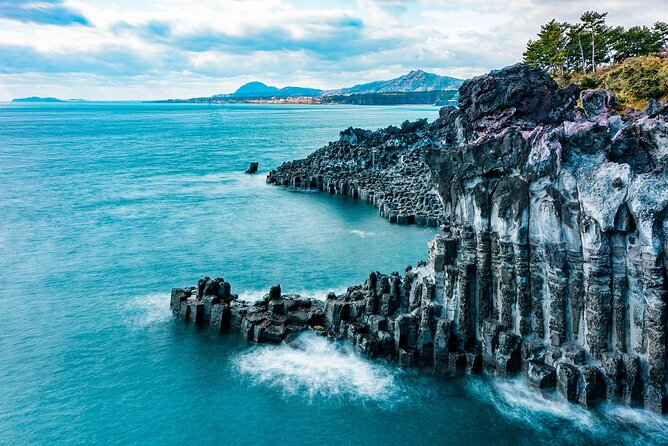
This is columnar joint coastline rock formations at the Jungmun Tourism Complex. The columns are described like a large folding screen, with black hexagonal stone pillars, and the UNESCO Geo Park status is noted.
You get about 50 minutes and admission is included.
This is the kind of place where you stop thinking about your schedule and just look. The waves hitting the columns give a sense of scale that is hard to get from a photo.
Jeju Art Circus (Jeju아트서커스)
Jeju Art Circus is an on-site performance stop, described as using Chinese technique circus style, plus Arirang, and a motorcycle show segment. The show is said to have started in January 2004 and is described as a well-known must-visit on Jeju. Admission is listed as free, and you get about 1 hour.
In rainy days, Hallasan can be replaced with Circus World, which suggests you will see a circus option if conditions make outdoor stops harder.
If you are tired of walking after two days, this is the mental reset. It also gives you a chance to experience a different side of Jeju, not just volcanic nature.
Value and pacing: what this tour does well for first-time Jeju visits
You are paying for a big-picture Jeju intro that mixes geology, culture, and a practical back-up plan. The pacing is also built around realistic times: about 40 to 50 minutes for most stops, then longer blocks where it matters, like Seongsan Ilchulbong.
I like that many admissions are listed as free for the nature and village stops. Then the paid ticket moments are concentrated on the major headline sites, like UNESCO areas and the cliff-and-falls stops that need tickets to enter.
If you are someone who hates the guesswork of where to go next, this tour’s biggest strength is the structure. You get an efficient two days, with the option to swap stops when the weather or closure schedule changes.
Weather, closures, and how to pack for a tour that actually runs on real conditions
This is not a “sun-only” itinerary. It is built to handle disruptions. Here are the main triggers you should plan around:
- Manjang Cave is noted as currently closed due to anti-falling construction until August 2025, with Hamdeok Beach as the substitute during that period
- Manjanggul Lava Tube can close on the first Wednesday of every month, with Haenyeo Museum as an alternative
- Rainy days can trigger replacements like Haenyeo Museum for Hamdeok Beach and Circus World for Hallasan
- Yongmeori Coast can deny entrance during rising tides or bad weather, with Mt. Songaksan as the alternative
Pack like you are on an all-weather schedule. Bring a light rain layer, sunscreen, and shoes that can handle damp ground. Even with substitutions, your time on site includes outdoor walks and uneven surfaces.
Also remember the tour asks for moderate physical fitness. That does not mean you need to be an athlete, but you should be comfortable with getting in and out of areas and doing short walks.
Who should book this tour, and who might want something different
Book this if:
- You want a structured Jeju UNESCO geology and culture intro in two days
- You dislike planning, transfers, and repeated ticket buying
- You like the idea of English language support and group pacing
- You can travel on the day you want based on East vs West scheduling, plus the K-drama timetable rhythm
Consider a private plan or a different format if:
- You are traveling with a very small group and you need a dedicated English-speaking guide for every stop
- Manjang Cave is your only non-negotiable, and you are traveling before it is scheduled to reopen in August 2025
- You want deep, slow travel. This is efficient. It is not designed for long unbroken wandering
One more practical tip. Pickup works best if your hotel is inside Jeju city downtown. If you are far out, the extra 80,000 KRW one way can quietly change your “value” math.
Quick thoughts on guides and the human side
I saw multiple examples of strong service in the tour experience, with names like Andy, Terry, Mr Kim, and Mr Lee popping up as highlights. What people seem to respond to is clear communication plus patience at stops, especially when a group is waiting and the schedule needs to stay on track.
When you book, ask the operator which day program you are actually joining and who will handle English. If you land at the small group end, confirm whether the driver will act as the main interpreter, or whether you will get a separate guide.
Should you book this Jeju UNESCO bus tour?
I would book it if you want the most Jeju per day without the stress. The mix of UNESCO geology like Seongsan Ilchulbong and the UNESCO Geo Park cliff formations, plus culture stops like Seongeup Folk Village and the Haenyeo Museum option, makes it feel like a complete island sampler.
The main reason not to book is simple. If Manjang Cave is the absolute reason for your trip and your dates fall before the August 2025 reopening, you should go in knowing Hamdeok Beach and Haenyeo Museum are likely substitutions.
FAQ
FAQ
What days does the tour run and how does East vs West work?
The itinerary schedule is tied to the day of the week. Western Jeju UNESCO runs on Mon, Wed, and Fri. East Jeju UNESCO runs on Tue, Thur, and Sat. There is also a K-drama East or West timetable that shapes the route.
Is hotel pickup included?
Yes, hotel pickup and drop-off are included within Jeju city downtown area. If your hotel is outside that area, there is an extra charge of 80,000 KRW one way.
What happens if Manjang Cave is closed during construction?
Manjang Cave is currently listed as closed due to construction to prevent falling hazards, with a scheduled reopening in August 2025. During construction, it is replaced by visiting Hamdeok Beach.
What if it rains during outdoor stops like Hallasan or Hamdeok?
On rainy days, Hallasan Mountain is replaced by visiting Circus World. Hamdeok Beach can be replaced by visiting the Haenyeo Museum.
Is the Yongmeori Coast always accessible?
No. Entrance may not be permitted during rising tides or bad weather. If it is closed, Mt. Songaksan is listed as the alternative course.
Do I get an English-speaking guide?
It depends on group size. Up to 4 people may join with a regular taxi driver who has advanced English skills. For groups of 5 to 10, you get a professional English-speaking guide. For groups larger than 10, the operator makes efforts to arrange a professional English-speaking guide with a van, minibus, or bus.
Recently reviewed in Jeju
- 9 Hour Private Day Tour Taxi in Jeju island (High recommend)★ 5.0 · 3 reviews
- Jeju UNESCO Natural Heritage Private Tour by Certified Guide★ 5.0 · 5 reviews
- Western Jeju Healing UNESCO Small Group Day Tour★ 5.0 · 5 reviews
- Jeju island Sunrise Tour Early Morning with Hotel Pickup★ 5.0 · 7 reviews
- West of Jeju island Bus Tour from Seogwipo city, Jeju island★ 5.0 · 13 reviews
- Jeju Island Popular Sightseeing Private Car Charter Tour★ 5.0 · 145 reviews
- West & South Jeju: Hallasan Trail, Waterfall, Tea Field Tour★ 4.8 · 180 reviews
- Jeju Customize Private VAN Tour of East or West or South (~8pax)★ 5.0 · 67 reviews
UNESCO Sites, compared.
Gyeongju UNESCO World Heritage Guided Day Tour
Read our review →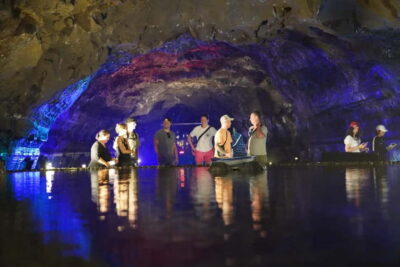
East Jeju Essentials – Seongsan Ilchulbong (UNESCO) & Haenyeo
Read our review →
Gyeongju UNESCO World Heritage Guided Day Tour from Busan
Read our review →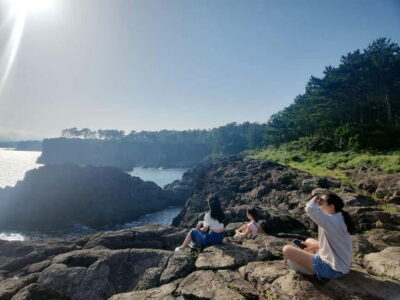
Gyeongju UNESCO sites Private tour with licensed tour guide
Read our review →
Private Gyeongju Tour – Explore Gyeongju UNESCO Sites
Read our review →Browse the lists this tour appears in