
Reviewed · PRIVATE DRIVERS
Private Tour South and West Jeju Island with Experienced Driver
Jeju’s south and west have a lot of moving parts, which is exactly why this private taxi tour is such a practical pick. You get the wow moments without the hassle, from Dokkaebi Road’s upside-down car illusion to ocean cliffs and waterfall views.
I particularly like how the day mixes big nature stops with food and tea, so you are not just driving from viewpoint to viewpoint. And I like that the guiding style can be family-friendly, with drivers such as Mr Kim (John Kim, Jinu Kim) or Ms Yang using a translation app when needed, then adjusting on the fly when conditions change.
One consideration is that you will do some light walking and stairs. Also, while many stops are free, Jeongbang Waterfall and Yongmeori Coast have paid entry, and lunch is extra.
Key highlights at a glance
- A full south and west circuit in one day, with pickup and return to your start point
- Dokkaebi Road optical illusion, with the simple slope explanation behind the parked-car trick
- Free oreum climb at Eoseungsaengak, a manageable hike with strong viewpoints on clear days
- Jeongbang Waterfall, the one that drops directly from land to the sea
- Seogwipo Maeil Olle Market, a real place to snack and understand daily Jeju life
- O’sulloc Tea Museum stop, including tea and desserts to cool down your legs
Why a private taxi tour makes south and west Jeju easier
Jeju can feel like a puzzle: cliffs here, waterfalls there, and long stretches where you really want a car. With this experience, you rent time, not stress. You sit in an air-conditioned vehicle, and the price covers fuel and parking, plus onboard WiFi, so you stay comfortable and connected.
The big value is pacing. South and west Jeju are spread out, and public transit can turn a fun day into a schedule that feels like a chore. Here, your driver can keep the flow of the day sensible, and that matters when you are juggling photos, short walks, and weather.
This also works well for groups with different energy levels. One review example that stands out is how Mr Kim was patient with older parents and kept the timing comfortable. If you are traveling with family, or if you want a smoother day than buses and taxis hopping between stops, this format fits.
A few more Jeju days side by side
- Jeju: Eastern Jeju UNESCO Spots Day Tour
★ 4.9 · 1,148 reviews - Jeju: Western and Southern Sightseeing Day Tour
★ 4.8 · 972 reviews - East Jeju Essentials – Seongsan Ilchulbong (UNESCO) & Haenyeo
★ 5.0 · 939 reviews
The first head-scratcher: Dokkaebi Road and the upside-down car effect
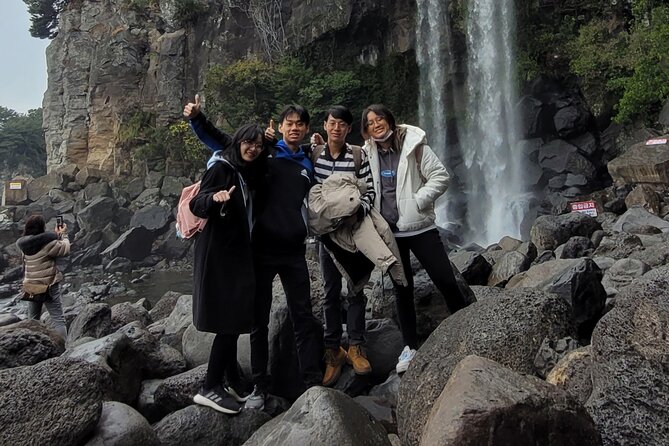
Dokkaebi Road, also called goblin road, is one of those places that makes you blink twice. You park your car on a downhill road, then the car appears to move uphill. The trick is simple: the visible side of the road is actually downhill with only about a 3-degree slope, so your brain reads it wrong.
What I like about this stop is that it is short and low-effort. You typically spend around 30 minutes, and you can get your photos and your moment of disbelief without turning the day into a long detour.
A fun detail to keep in mind: the story people love is that in 1981 a newlywed couple stepped out of a taxi and took a picture, then watched the parked taxi seem to go up the hill. It is basically a “wait, what?” moment that has been copied for decades.
Practical tip: take your photos quickly, then slow down and watch what your driver points out. The illusion gets easier to understand once you know where to stand and how the viewing angle changes the effect.
Eoseungsaengak Peak: the oreum climb that pays off fast
Next comes Eoseungsaengak Peak, a favorite oreum for lighter climbs. Oreums are Jeju’s smaller volcanic hills, and this one is known for being approachable while still delivering satisfying views.
You will usually have about 1 to 2 hours total for this segment, including time on the hill. The summit hike is about 1.3 km to the top, and it is roughly 30 minutes one way for many people. The entrance is near the Eorimok Visitor Information Center, and the area is used as a nature learning trail, which helps keep the ecology protected.
What you can see on a clear day is a big part of the appeal. From the top, you can look toward Chujado Island, Biyangdo Island, and Seongsan Ilchulbong Peak.
Then there is the old-world detail. At the top, remnants of a Japanese military facility called Tochka (built in 1945) are still there. There are trenches that once connected it to an underground fortress at the waist of Eoseungsaengak, but today the connections are sunken and blocked.
Why this stop is worth it: it is not just a viewpoint. You get a short hike, then a sense of how Jeju’s volcanic terrain shaped military strategy. You do not need to be a history person to appreciate it, though.
Practical tip: if you feel your pace slipping, slow down early. The hike is short, but the weather on Jeju can switch quickly. Bring a light layer, even if it seems warm at pickup.
Jeongbang Waterfall: a classic, with real structure and sound
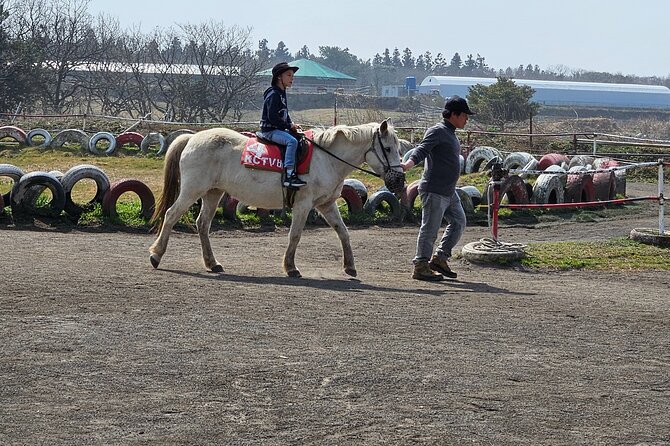
If you only did one waterfall on Jeju, Jeongbang Waterfall is a strong choice. It has the “wow” factor because it is the only waterfall in Korea that falls directly from land to the sea.
Expect scale. Jeongbang is about 23 m high, 8 m wide, and 5 m deep. The setting is also very visual. You descend about 5 minutes on stairs through pine trees, then you are hit with both sound and sight: the cool noise carries, and you can see vertical rock walls on both sides with columnar joints.
There is also a detail about the water itself. In sunlight, the water can turn a milky tone that people describe like a Milky Way effect. It is not guaranteed, but when it lines up, it looks like the spray is doing its own light show.
Cost note: admission is 2,000 KRW (about $1.6) per person, and it is not included.
Time note: plan around 1 hour here. That is enough to descend, view from a few angles, and take photos without rushing.
Possible drawback: if it is windy or visibility is low, it can feel harder to get those sharp photos. Still, the sound and the structure make it worth seeing even when the lighting is not perfect.
Different day, same base:
- Jeju: Southern Top UNESCO Spots Bus Tour
★ 4.9 · 648 reviews - South-West Jeju Essentials: Hallasan & Signature Highlights
★ 5.0 · 620 reviews - Jeju Island English Private & Flexible Tour any number anywhere
★ 5.0 · 561 reviews - Jeju: West & South Full-Day Authentic Tour
★ 5.0 · 359 reviews
Seogwipo Maeil Olle Market: eat like you are living on Jeju
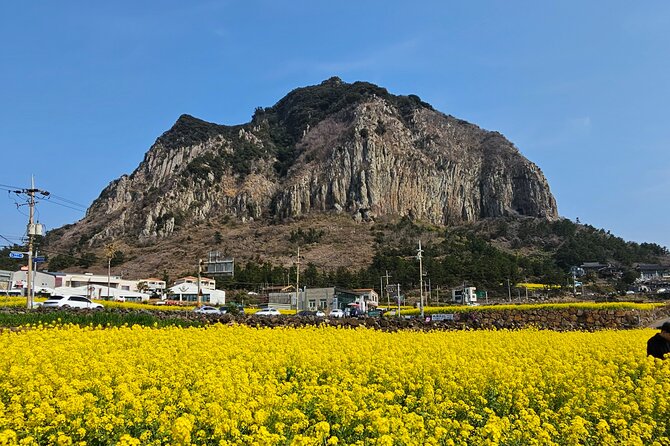
After nature and stairs, you will want something that feels like daily life. Seogwipo Maeil Olle Market, sometimes called Seogwipo Daily Olle Market, is the right kind of stop for that.
This is a traditional market in the center of Seogwipo City, and it is described as the largest and oldest permanent market in Seogwipo-si. It is active 365 days a year, which is exactly what you want when you are trying to understand how people actually shop and eat here.
Time for this is around 30 minutes, so you are not doing a full market marathon. You are doing a smart snack and browse loop.
What you can find includes Omegi rice cakes, tangerines, hallabongs, jade fish, silver cutlassfish, and black pork. You do not need to commit to a full meal inside the market. Even a few bites can give you the flavor of Jeju without blowing your day’s schedule.
If lunch is on your mind, the tour offers Korean traditional lunch separately, typically around 15,000 KRW per person. That is not included, but it is a helpful option when you want something filling after the waterfall.
Practical tip: markets are best for short, decisive wandering. Go in with a plan like I want one sweet, one savory, then I leave. Otherwise you can end up eating a lot and feeling tired before your coast walk.
Yongmeori Beach: dragon-shaped cliffs and wave-carved caves
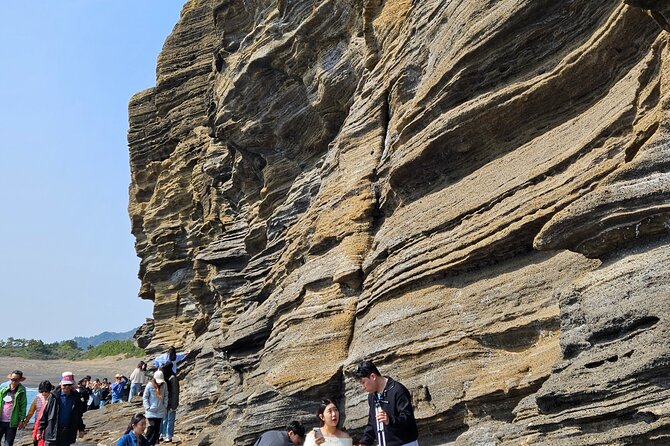
Now for geology and drama. Yongmeori Coast sits at the foot of Sanbangsan Mountain and stretches along the sea. The name comes from the way the coastline resembles a dragon head going into the water.
The rock story is the point. These cliffs are made of layered sandstone, built up over tens of millions of years, then carved by wave action. You will see weird angles, long cliff faces, and spots that look like the sea carved out rooms.
There is also a narrow route in front of the cliffs, a flat wave grove that acts like a trail. It is roughly 30 minutes to look around, but many people spend longer by choosing photo angles and walking slightly off the main loop.
Admission cost: 2,000 KRW (about $1.6) per person. Not included.
Time note: you should plan around 2 hours total for this stop, which gives you breathing room if the weather turns or if you want to slow down at the best viewpoints.
What I like here: it feels like a nature set built from time and waves, not a staged attraction. The cliff shapes look different from different angles, so it is worth moving slowly rather than taking one quick photo and calling it done.
Practical tip: wear shoes with good grip. Coastal rock can be slick, even when it looks dry.
Oedolgae and the promenade toward Seonnyeotang
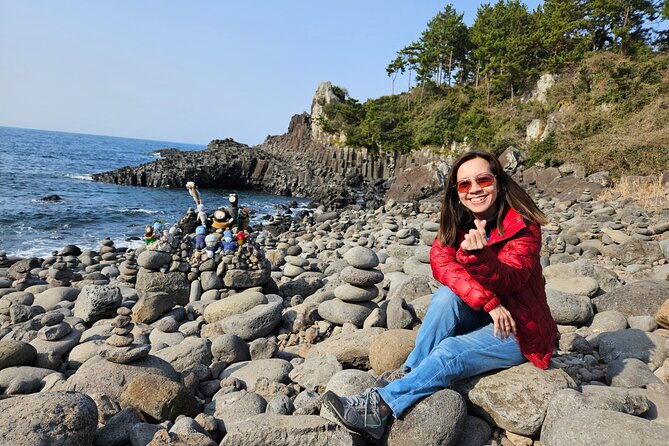
From Yongmeori you shift to another famous sea-rock scene: Oedolgae. This is a stone pillar about 20 m tall with a width around 7 to 10 m, formed by wave erosion in a lava field from a volcanic eruption.
The name is literal. Oedolgae means a rock standing alone in the sea. You may also hear it called General Rock and Grandma Rock, with local legends tied to those names.
This area is designated Scenic Beauty No. 79 (designated in 2011), and it is linked with Sanbangsan Mountain and Soesokkak in the same scenic category group.
After you meet Oedolgae, the flow of the day continues with a relaxed walk along a promenade to Seonnyeotang on the Hwanguji Coast. From there, you can look toward Saeseom Island and Saeyeongyo Island.
Time note: about 1 hour total.
Why it works in a route like this: it gives you a calmer, walk-and-look pace after cliff walking. You get ocean views, then you can stretch your legs without committing to a steep hike.
Practical tip: bring a light wind layer. Sea air can feel colder than inland Jeju.
O’sulloc Tea Museum: the easy reset between viewpoints
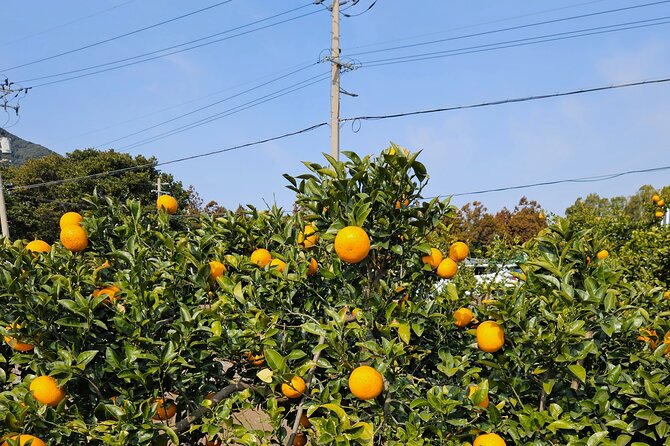
Before you head back, you have a nice indoor, low-stress stop at O’sulloc Tea Museum. This is a tea-focused break that fits well at the end of a full day.
O’sulloc’s name includes the meaning of oh, like a light exclamation, and the brand origin is tied to O’sulloc cha. Inside, you get the sense of tea culture fast: you smell green tea as you move through the space, and you can see tea fields through the glass.
The tour experience here is built around tasting. You can enjoy hot tea brewed by the tea master, plus options like ice cream made with O’sulloc green tea and roll cakes. One food detail that stands out is the dark green green tea roll cake, which is described as not too sweet, a nice option if you do not want dessert overload.
Admission at this stop is listed as free, and time is about 1 hour.
Value angle: it is not just a souvenir stop. You get a break from sun and stairs, then a small treat that feels worth the detour.
Practical tip: if you are traveling with anyone sensitive to strong flavors, you can still do tea and skip the sweets. The tasting side is flexible.
Price and logistics: where the money goes, and where it does not
The base price is $62 for about 8 to 9 hours. That is a full-day amount of driving and guiding, not a quick hop between two points. The tour includes an air-conditioned vehicle, WiFi, and fuel and parking.
The costs that can add up are mostly food and two admissions:
- Jeongbang Waterfall: 2,000 KRW per person
- Yongmeori Coast: 2,000 KRW per person
- Lunch: typically 15,000 KRW per person if you choose the Korean traditional lunch option
- Gratuities: not included, and are recommended
- Personal expenses: not included
I like this cost structure because it is easy to plan. Most stops are free, including Dokkaebi Road, Eoseungsaengak, Oedolgae, the market, and O’sulloc.
One more logistic detail: the pickup point and end point are the same, at 1526-1 Yongdam 2(i)-dong, Cheju, Jeju-do, South Korea. That reduces time waste. You are not crossing the island to find a drop-off spot.
Weather note: the experience is described as requiring good weather. If weather shuts it down, you should expect an offered alternative date or a full refund.
Who this tour suits best
This is the kind of day that fits:
- Families who want a private driver and less walking than a full hiking day
- People who want to see a lot of Jeju without renting a car
- Anyone who wants English-friendly support, since guides like Mr Kim and Ms Yang can work through language gaps with tools like translation apps
- First-time visitors to Jeju who want a focused route through south and west highlights
It may not fit as well if you hate stairs or you need a mostly flat day. You will handle stairs at Jeongbang, and you will hike a bit at Eoseungsaengak and walk the coast trails at Yongmeori.
Should you book this private south and west Jeju taxi tour?
I think it is a smart booking if you want value and efficiency. For a long day, you are paying for transportation plus a route that mixes illusion, waterfall, market food, coast geology, and tea. It is also a good match for groups that benefit from patience and adjustments, as shown by drivers like Mr Kim.
Book it if you:
- Want a private day with pickup and return to one location
- Like short, varied stops rather than one giant hike
- Are okay paying small admission fees for Jeongbang and Yongmeori, plus lunch if you choose it
Skip it if you:
- Want a full-on hiking day with long trails and hours of climbing
- Are looking for a completely admission-free day with zero extra costs
If you want south and west Jeju in one organized, comfortable sweep, this is the kind of tour you will feel good about the moment you step into the car.
FAQ
How long is the private South and West Jeju Island tour?
It runs about 8 to 9 hours.
Is pickup offered?
Yes, pickup is offered, and the tour ends back at the meeting point.
What is included in the tour price?
WiFi on board, an air-conditioned vehicle, and fuel and parking fees are included.
Which attractions cost extra?
Jeongbang Waterfall has an admission fee of 2,000 KRW per person, and Yongmeori Coast also has an admission fee of 2,000 KRW per person. Other listed stops are free.
Is lunch included?
Lunch is not included. A Korean traditional lunch option is about 15,000 KRW per person.
How much walking is involved?
You should have a moderate physical fitness level. Expect stairs and a light climb at Eoseungsaengak, plus walking around Yongmeori and Oedolgae areas.
What if the weather is bad?
The experience requires good weather. If it is canceled due to poor weather, you will be offered a different date or a full refund.
Recently reviewed in Jeju
- 9 Hour Private Day Tour Taxi in Jeju island (High recommend)★ 5.0 · 3 reviews
- Jeju UNESCO Natural Heritage Private Tour by Certified Guide★ 5.0 · 5 reviews
- Western Jeju Healing UNESCO Small Group Day Tour★ 5.0 · 5 reviews
- Jeju island Sunrise Tour Early Morning with Hotel Pickup★ 5.0 · 7 reviews
- West of Jeju island Bus Tour from Seogwipo city, Jeju island★ 5.0 · 13 reviews
- Jeju Island Popular Sightseeing Private Car Charter Tour★ 5.0 · 145 reviews
- West & South Jeju: Hallasan Trail, Waterfall, Tea Field Tour★ 4.8 · 180 reviews
- Jeju Customize Private VAN Tour of East or West or South (~8pax)★ 5.0 · 67 reviews
Private Drivers, compared.
2 Days Private Tour with a Very Experienced Driver in Jeju Island
Read our review →
Private 2Days Tour a lot of Experience Driver in jeju island
Read our review →
Private English Speaking Driver in Seoul: Airport Service Available
Read our review →Browse the lists this tour appears in